
Estimated reading time: 13 minutes
Renting in 2026 doesn’t look like it did five years ago.
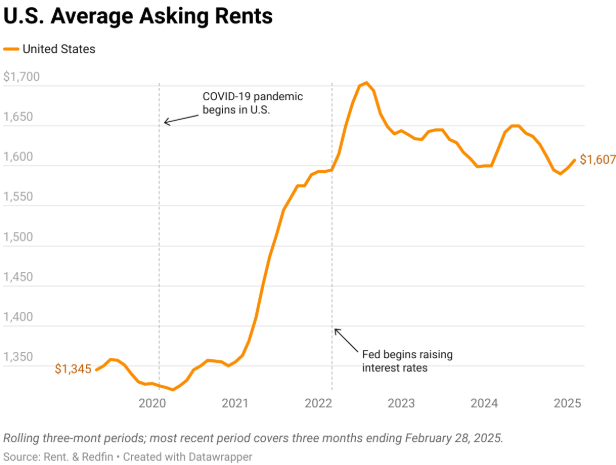
The scramble of the pandemic years is mostly behind us. People aren’t panic-moving across cities, construction has caught up in a lot of markets, and high interest rates have quietly pushed a whole group of would-be buyers back into renting. Look at how the asking rents are settling now.
Contents
What’s changed is how people decide where to rent. It’s no longer just about finding the cheapest listing or the newest building. Cost still matters, obviously.
But so does how your life actually functions once you’re there: how long your commute eats into your day, whether errands require a car, how a neighborhood feels after work, and how easy it is to leave if your job, relationship, or priorities shift.
Smart renters know this: The most affordable city on paper might cost you more if you’re spending hours commuting or struggling to access basic services.
June Homes exists for renters thinking this way, offering furnished apartments, flexible leases, and neighborhoods chosen for how people actually live in them. If you’re trying to find a place that fits your rhythm, let’s dig in.
Methodology: How We Chose the Best Cities
When renters compare cities, they usually circle back to the same three questions.
- Can I afford it?
- Can I adapt if my plans change?
- And will I actually enjoy living there?
“Choosing the right city isn’t just about cost or flexibility; it’s about daily quality of life. Access to wellness resources and reliable infrastructure shapes how residents experience a neighborhood. Fitness shouldn’t be a luxury — it should be a lifestyle,” says Wang Dong, Founder at Vanswe Fitness.
So that’s how we built this list: cost, flexibility, and lifestyle.
Cost
We looked at typical one-bedroom and two-bedroom rents, but rent is only part of what you pay each month, so we also factored in everyday expenses like groceries and utilities.
To ground this in reality, we used benchmarks from the Zillow Observed Rent Index and the Apartment List National Rent Report to see where prices are now, and where they’re headed.
Research from the Harvard Joint Center for Housing Studies helped us keep the bigger housing picture in mind, not just short-term swings.
Flexibility
We looked at how common short-term leases and furnished apartments are, whether roommate-friendly layouts are easy to find, and how often renters can extend or transfer without unnecessary friction. We wanted to find cities that were easy to find residence in.
This also means we paid attention to new housing supply, since more inventory usually means more choice.
Lifestyle
This rounded it out. It’s the hardest to reduce to a number, but renters feel it immediately once they move in.
We ALSO focused on neighborhoods with strong livability, something we defined by walkable streets, reliable transit, access to parks, and a sense that something is happening beyond just work and sleep. Data from Walk Score, the Trust for Public Land’s ParkScore, and regional pricing data from the BEA helped us with these judgments.
In the final scoring, affordability carried 40% of the weight, with flexibility and lifestyle at 30% each.
In these markets, renters benefit from access to qualified professionals, such as a licensed electrical contractor, which directly improves daily living. Reliable service ensures apartments meet safety standards, repairs occur promptly, and life at home stays predictable. When comparing cities long-term, strong infrastructure and professional support often separate a rental that looks affordable on paper from one that truly feels livable.
Read our guide if you’re moving alone to a brand new city.
Top 10 Best Cities for Renters in 2026
So what does all of that look like in practice? These are the cities where the numbers make sense, and daily life doesn’t feel like a compromise.
Minneapolis, Minnesota
Minneapolis didn’t really market itself as renter-friendly. It just kept adding housing. And that’s what you notice when apartment hunting. There’s more than one option.
You’re not racing ten people to refresh the same listing. Rents still feel reasonable for a city of its size, especially once you’re a few neighborhoods away from the obvious spots. In fact, the rent here is one of the most stable variables, as you can see below.
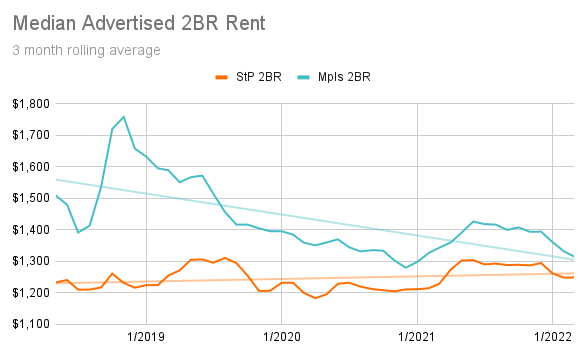
Most one-bedrooms you’ll see land somewhere in the mid-$1,000s, and even two-bedrooms tend to stay under what coastal studios cost.
Daily life is normal here. Bike paths actually connect the places you go to. People walk around the lakes after work like it’s nothing special. Groceries don’t feel too expensive. Newer buildings tend to assume renters might want flexibility, so they offer shorter terms, furnished units, and layouts that make sense if you’re sharing. Winters are long, yes, but the parks are genuinely good, and the arts scene feels intimate and relevant to the people who live there.
Pittsburgh, Pennsylvania
Pittsburgh is cheaper than people expect, and calmer than people assume. Those two things go together. It’s still possible to find a decent one-bedroom without creeping past the mid-$1,000s, which changes how the rest of your budget works.
Rent doesn’t dominate here. Sharing a place still makes sense without it feeling like a downgrade. Neighborhoods are close enough that getting across town doesn’t become a daily project. You don’t slowly start spending more just to exist.
Housing is mixed in a good way. Older buildings, small landlords, renovated spaces. That usually means more room to ask for flexibility without it being a whole thing. Outside your apartment, life is pretty grounded. Neighborhoods feel different from each other. Food is better than it gets credit for. There’s green space close enough that you actually use it. Pittsburgh works if you want things to feel manageable.
Columbus, Ohio
Columbus feels like it’s in motion, but not spiraling. Jobs have been growing steadily, and people seem cautiously optimistic about staying put for a while. Renting here still feels doable. Compared to faster-growing metros, Columbus rents still pencil out, especially if you’re open to neighborhoods just outside the core. You can live alone or with roommates without immediately feeling priced out.
What helps is how much has been built. When there’s competition, landlords behave differently.
Morgan Taylor, Co-Founder at Jolly SEO, sees this shift reflected in how renters research growing cities like Columbus.
Taylor says, “When a city is still renter-friendly, you see it in search behavior. People aren’t just asking about rent, they’re looking up commute times, grocery access, and whether neighborhoods feel finished or still in flux. In places like Columbus, the answers aren’t full of warnings or workarounds, and that’s usually a sign the market hasn’t turned hostile yet.”
Lifestyle has filled in over time, too. Areas like Short North feel active without being exhausting. The food scene has improved quietly. Columbus feels like a city that’s growing up without forgetting renters exist.
Kansas City, Missouri
Kansas City’s changes are the kind you notice even if you’re not looking for them. A new airport. The streetcar is going further. More apartment buildings than there used to be.
That extra supply shows up in rent conversations in the form of space that feels generous for what you’re paying, and furnished places aren’t rare finds.
Outside of housing, KC feels settled. Music is just part of life. People care about food in a serious but unpretentious way. Neighborhoods feel like places people actually stick around in. Kansas City works if you want options without constant churn.
One-bedrooms generally hover in the low-$1,000s, and two-bedrooms offer more space than the number suggests.
Raleigh–Durham, North Carolina
The Triangle isn’t flashy, and that’s kind of why it works. Rents have risen, but not wildly, single apartments typically sit around the $1,400–$1,600 range, with two-bedrooms scaling from there.
Jobs come from a few different directions: universities, healthcare, and startups, so things don’t swing wildly. Renting here feels stable. You’re not constantly bracing for the next jump.
Flexibility exists, but quietly. Newer buildings tend to allow shorter terms. Shared layouts are common. Furnished options show up without being a gimmick. Daily life is calm. Greenways get used. Coffee shops double as workspaces. It’s a place that makes sense if you don’t want to rethink your housing every year.
Austin, Texas
Austin isn’t cheap, but it’s less chaotic than it was. Singles often land between the mid-$1,400s and $1,700s, depending on how central you want to be.
After a lot of building, the market cooled. Rents didn’t crash, but they stopped sprinting. Deals started appearing again. New buildings want tenants, not headlines.
The lifestyle is still there with music, outdoor swimming spots, food that keeps changing, but the pace is different. Less frantic. Fewer bidding wars. Austin makes more sense now if price was the reason you hesitated before.
Philadelphia, Pennsylvania
Philadelphia feels dense without being overwhelming. You can live in a neighborhood where everything you need is nearby and still feel like you have room.
Rent is noticeable, but not punishing. Two-bedrooms can cross into the low-$2,000s, but you’re often getting more space and better transit access for it. If you pick a transit-heavy area, you don’t need a car, which saves a lot. Groceries and daily costs stay reasonable.
Housing varies block to block. Rowhomes, small buildings, newer places. That variety helps with flexibility. Lifestyle is the payoff. Museums you actually go to. Food people argue about seriously. Neighborhoods that don’t blur together. Philly works if you want city energy without constant pressure.
Milwaukee, Wisconsin
Milwaukee doesn’t try to convince you. Rent stays manageable. One-bedrooms here often sit just above the low-$1,000 mark, and two-bedrooms stay comfortably below big-city pricing.
Living near the lake doesn’t feel like a luxury reserved for someone else. Transportation costs don’t sneak up on you. Budgets stretch further here than people expect.
Development added options without wiping out the character. Shorter leases are easier to find now. Life feels social in a low-key way with festivals, parks, and neighborhoods where people recognize each other. Milwaukee makes settling in easy.
New York City, New York
New York never leaves the conversation, does it?
Rent is high. That part doesn’t go away. But it’s steadier than it was during the surge years, and outside the most competitive neighborhoods, it’s less chaotic than people assume. Co-living in NYC is also a viable option.
Citywide averages mask a lot, but many one-bedrooms still land somewhere in the low-to-mid $3,000s unless you’re deep in Manhattan or prime Brooklyn. Have a quick look at how the asking rent changes according to where you’re looking:
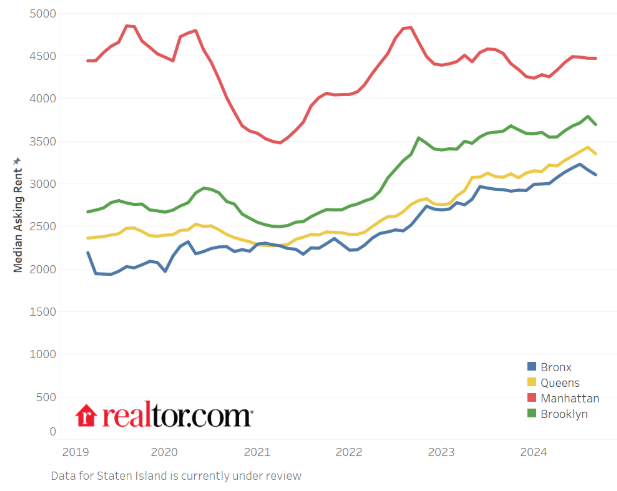
What you’re paying for isn’t space. It’s access. No car. Everything nearby. The ability to change jobs, routines, or plans without uprooting your life. Flexibility is baked into the culture, roommates, sublets, furnished places, and short-term setups. New York works if you value options more than certainty.
Shan Abbasi, Director of Business Development at PayCompass, sees the downside of that flexibility when renters move fast without verifying the money side.
Abbasi says, “In cities like New York, speed works both ways. People are subletting, transferring leases, paying deposits quickly, and that’s where mistakes happen. The safest setups are boring ones: payments tied to a platform, a documented lease, and no last-minute changes to where money goes. If flexibility comes with pressure to pay immediately or off-platform, that’s usually a sign something’s off.”
Boston, Massachusetts
In Boston, one-bedrooms commonly fall in the high-$2,000s, with two-bedrooms stepping up sharply depending on proximity to transit and universities. You can use this Boston rent calculator to arrive at an ideal rent figure for you.
Boston can feel expensive until you live inside it for a bit. The city is compact. Daily logistics are simple. Walks are short. Transit works. Rent is high, yes, but it doesn’t come with the same sprawl or chaos as larger cities.
Demand stays steady because the job base doesn’t swing much. Around universities, flexibility is normal with shorter leases, sublets, and furnished places. Lifestyle is structured and predictable. Boston works if you like order.
Adrian Iorga, Founder and President at Stairhopper Movers, sees how this flexibility shapes renter behavior across Boston’s neighborhoods.
Iorga says, “Boston renters move more often than people think, but usually in small jumps. Someone finishes a lease near Fenway and ends up in Somerville. Another moves from Allston to Cambridge to shorten a commute by ten minutes. That only works because sublets, shorter leases, and mixed housing stock are normal here. When flexibility disappears, people stop optimizing their lives and just settle.”
Washington, DC
One-bedrooms often sit in the low-to-mid $2,000s, with two-bedrooms scaling up in transit-heavy neighborhoods. DC feels intentionally built for renters. A lot of people move through for work, and housing reflects that. Shorter leases and furnished options are common, especially in newer buildings.
Day-to-day life is calmer than outsiders expect. Neighborhoods are walkable. Parks are everywhere. Museums become part of normal routines instead of special trips. DC works if you want stability without feeling boxed in.
Affordability and Rent Trends in 2026
If you zoom out, the rent story over 2024 and 2025 can be explained. After years of underbuilding, a lot of apartments finally came online at once. Construction hit levels we hadn’t seen in decades, especially in fast-growing metros, and that took some of the edge off rent growth. By the time we rolled into 2026, that backlog of new supply was still doing its job. In many of the cities we looked at, rents either flattened out or crept up slowly instead of jumping.
The big split has been familiar: parts of the Midwest and smaller East Coast markets saw steady, manageable increases, while some boomtowns that built the most (Austin, Phoenix) notched slower growth or slight declines compared to 2022 highs.
Higher mortgage rates kept more households renting, but the sheer amount of new supply stopped the kind of run-ups we saw earlier in the decade. Inflation has cooled from its peak, and while shelter inflation lags in official numbers, on-the-ground rent trends have been gentler where cranes were busiest.
The Rental Market Beyond 2026
Two forces will likely shape the next stretch: technology and zoning.
- Expect more AI-powered tools to help you match with the right home, not just any home. Finding the perfect rental will get as personalized as streaming recommendations.
- AI matching systems will factor in your lifestyle preferences, commute patterns, and budget to suggest properties you might never have discovered on your own.
- Virtual tours and digital lease signing are just the start.
On the policy side, more cities are opening the door to gentle density with ADUs, duplexes, and small apartments, which can expand choices and stabilize prices over time.
Office-to-apartment conversions won’t save every downtown, but they’re adding meaningful units in the right buildings and neighborhoods. If that trend continues, renters could see fresh options in locations that once felt off-limits.
Final Note
The best city for renters in 2026 is the one that matches your budget, your flexibility needs, and the way you want to live. For some, that’s a Midwestern metro where your dollar stretches. For others, it’s a Sun Belt city where new supply means real negotiating power. And for many, it’s somewhere with parks, a quick commute, and a lease that bends with your plans.
Start with the data and then trust your instincts on the feel of a place.
And when you want furnished options and flexible terms in neighborhoods you’ll actually love, June Homes can help you line up a home that fits the way you live today, and how you might live next season. The rental market’s supply wave is creating real opportunities for renters who know what to look for, and the resources linked above are a solid place to begin your search.
