
This year, we took a closer look at how students rent. We combined three years of internal tenant data from across our platforms with a survey we ran in early 2026 among current and former tenants. The results surface some real patterns , and a few that cut against common assumptions about who student renters are and what they actually need.
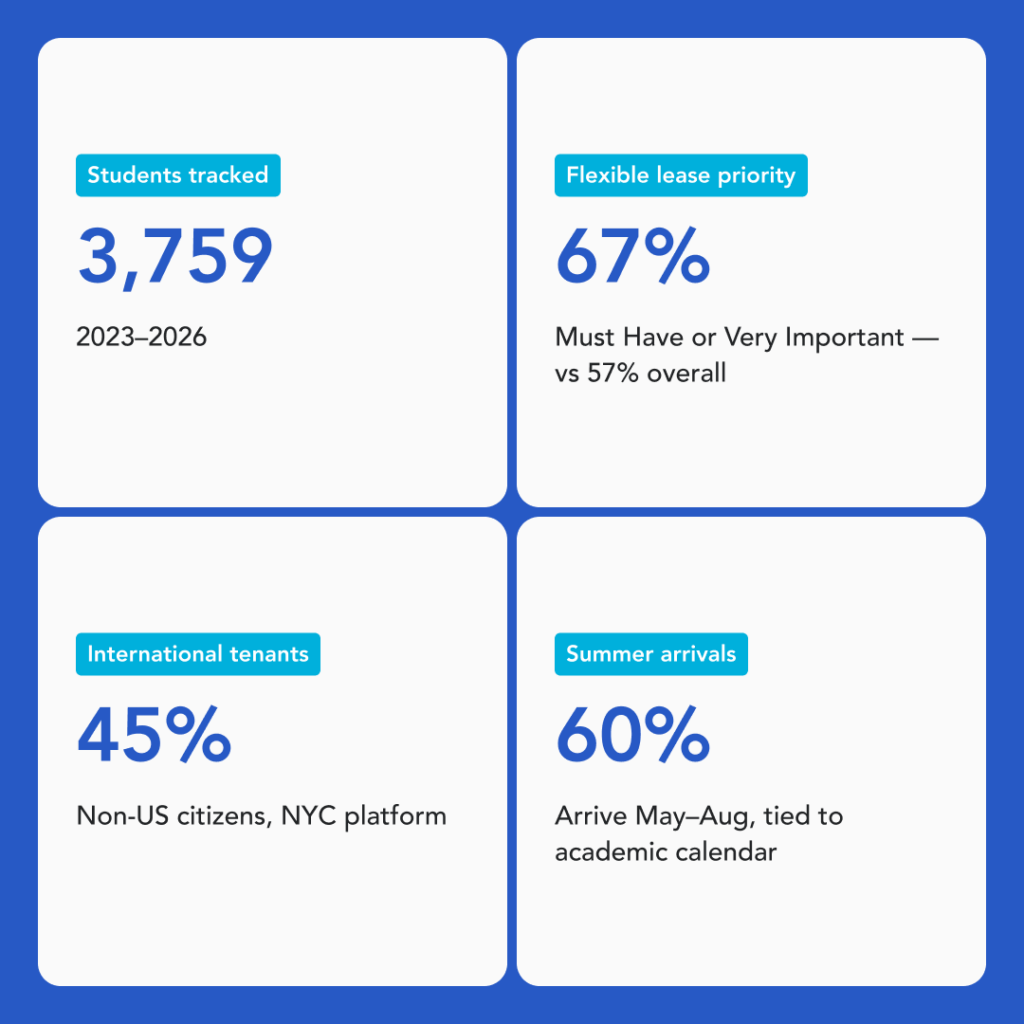
Behavioral data draws from 3,759 unique student tenant records on our New York City platforms, January 2023–June 2026 — our largest and longest-running market. Attitudinal data draws from a 130-response survey of current and former tenants across Outpost and June Homes markets including New York City, Boston, Washington D.C., Chicago, and Los Angeles, conducted March 2026.
Flexibility isn’t a perk — it’s the baseline requirement
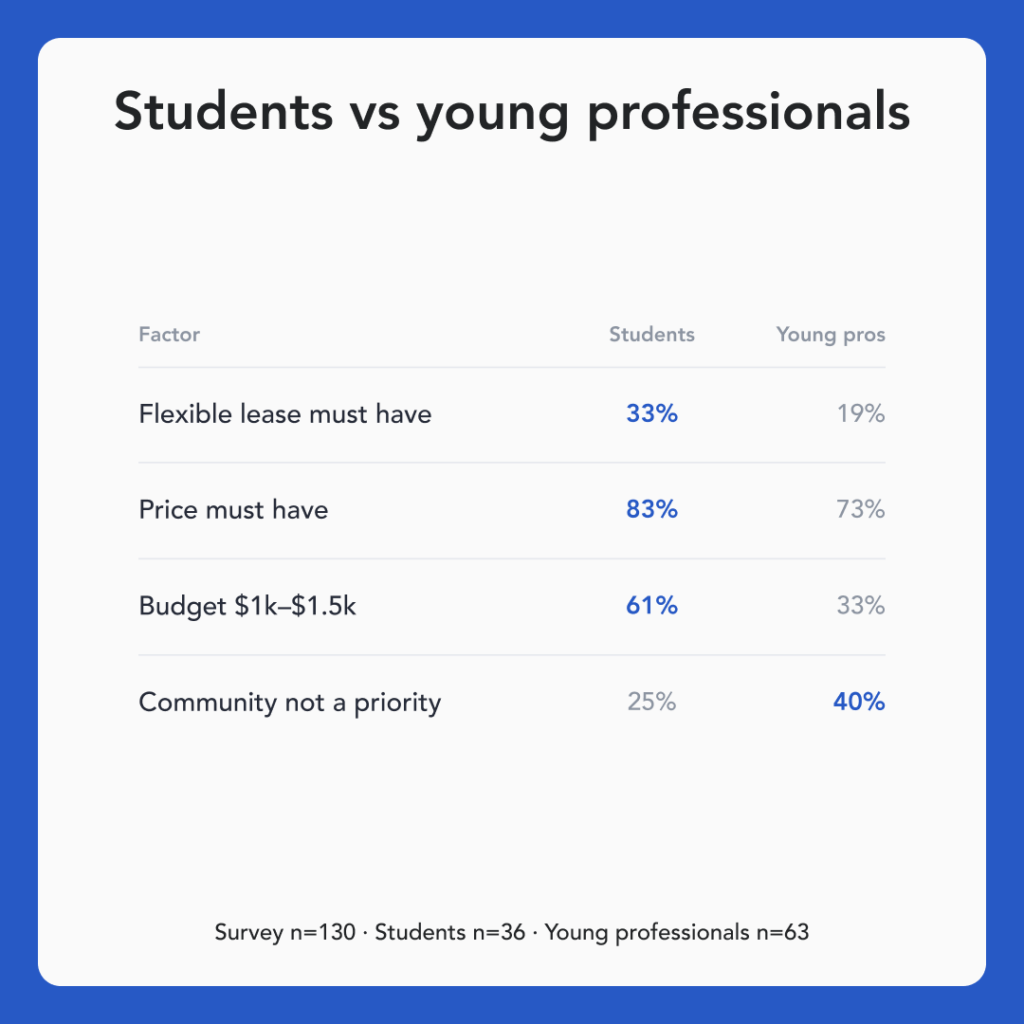
When we surveyed renters earlier this year, 57% of all respondents rated flexible leasing as a must-have or very important. Among students specifically, that number rises to 67%: 1 in 3 students rates it a flat-out must-have, compared to 1 in 5 young professionals. That gap didn’t narrow when we looked at international students: 73% of international student respondents flagged flexible leasing as a must-have or very important, the highest rate of any segment we tracked.
What makes this finding more than a stated preference is that the behavioral data says the same thing. Of the students who rented through our platforms since 2023, nearly half stayed for 3 months or less. Around a third stayed beyond 6 months. The distribution isn’t clustered around one typical stay length, it spans a wide range, from a summer internship to a full academic year, which is itself a meaningful signal about the kind of housing flexibility students are actually navigating.
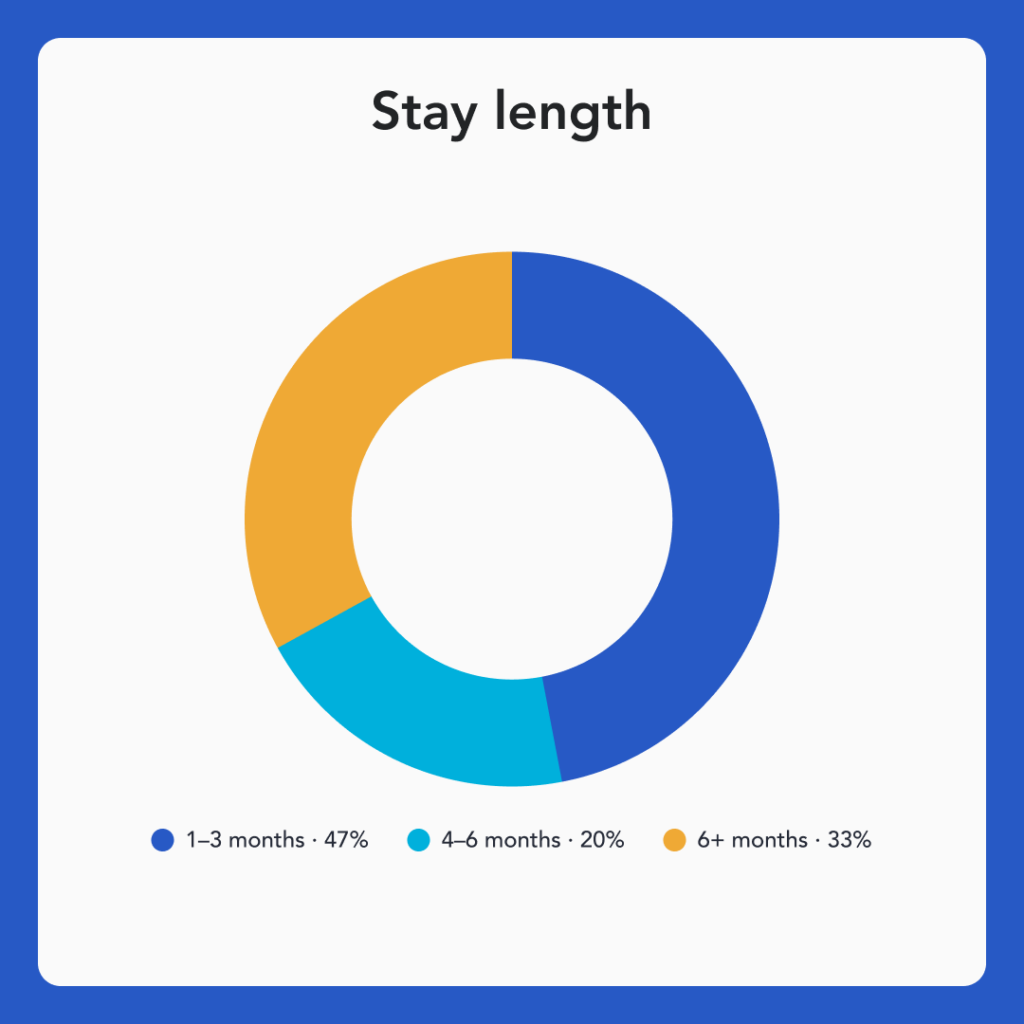
The contrast with young professionals is consistent across both datasets: students are more likely to want a short, defined lease term, and the actual stay-length data confirms they follow through on it.
Price sensitivity is sharper for students — and the gap is significant
83% of student survey respondents called price a must-have, compared to 73% of young professionals. That ten-point gap is the largest we found across any of the priority dimensions we measured.
The budget data explains why. 61% of students reported a monthly housing budget of $1,000–$1,499 — nearly double the rate of young professionals sitting in that same bracket (33%). Students aren’t just price-sensitive in the abstract. They’re operating with real ceiling constraints that put most solo apartments in major cities out of reach from the start.
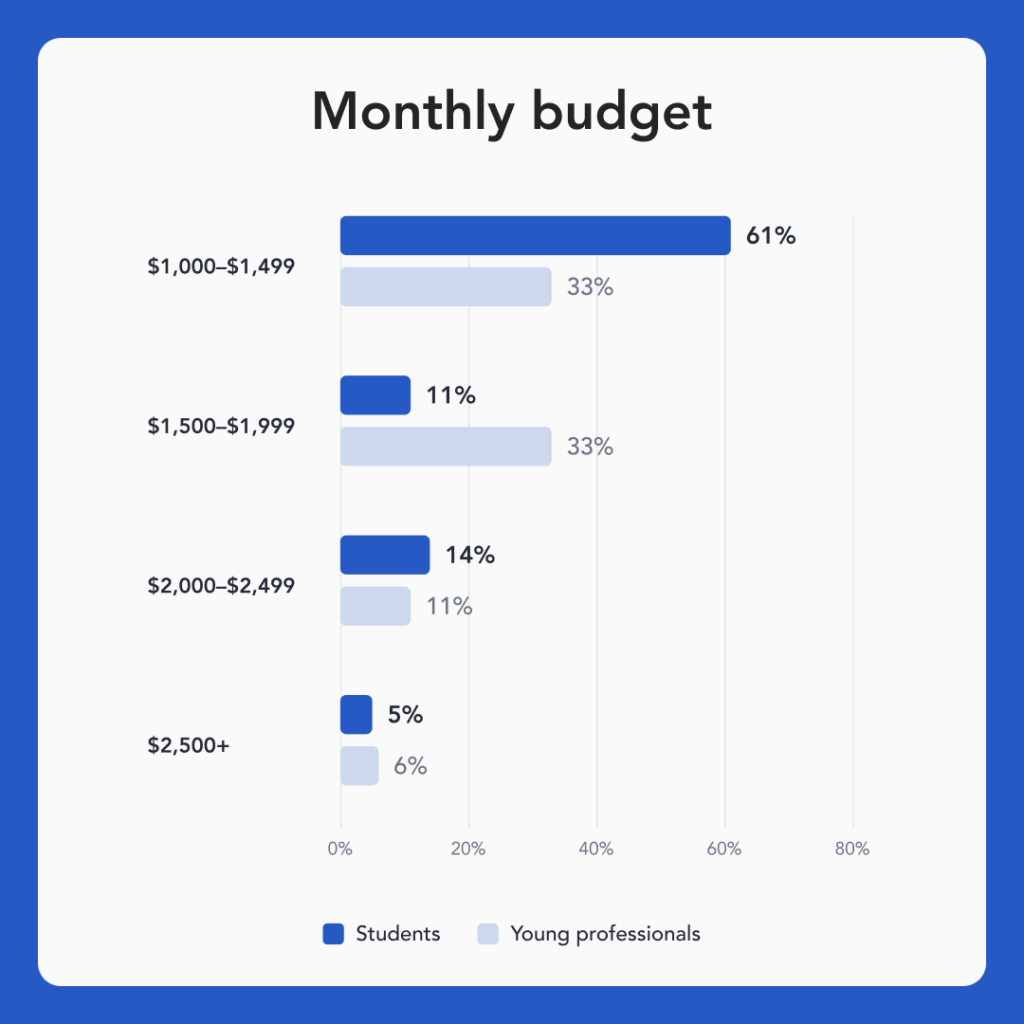
This matters because it reframes the flexibility question. A student choosing a short-term furnished room isn’t optimizing for lifestyle convenience, they’re often solving a math problem. Any lease requires a deposit and upfront costs, but a longer commitment at market rate compounds that pressure: the math simply doesn’t work against a four-month internship or a one-semester program. The flexible lease isn’t an upgrade. It’s what makes the move viable.
Almost half of student tenants are international
45% of students who rented with us over the past three years are non-US citizens. That figure includes tenants from France, Germany, South Korea, Japan, Brazil, and a range of other countries — not occasional outliers, but a consistent near-majority across the full dataset.
For an international student arriving in the US, the standard rental process creates immediate friction. No US credit history. No domestic guarantor. An unfamiliar legal structure. Most standard leases assume a renter who has been building a financial profile in the US for years. An international student arriving for a semester or a summer program hasn’t, and often can’t quickly enough to qualify through traditional channels.
The survey data reflects this directly: the international student cohort showed the highest flexible-lease priority of any group we tracked, consistent with the idea that flexibility isn’t just preferred, it’s often the only practical path to securing housing at all.
This represents a structural gap in the US rental market, not a niche preference. International student enrollment in the US has trended upward for years. These renters are arriving in large and predictable numbers, overwhelmingly concentrated in major metros, with housing needs the traditional market is not well set up to serve.
Demand is seasonal, concentrated, and calendar-driven
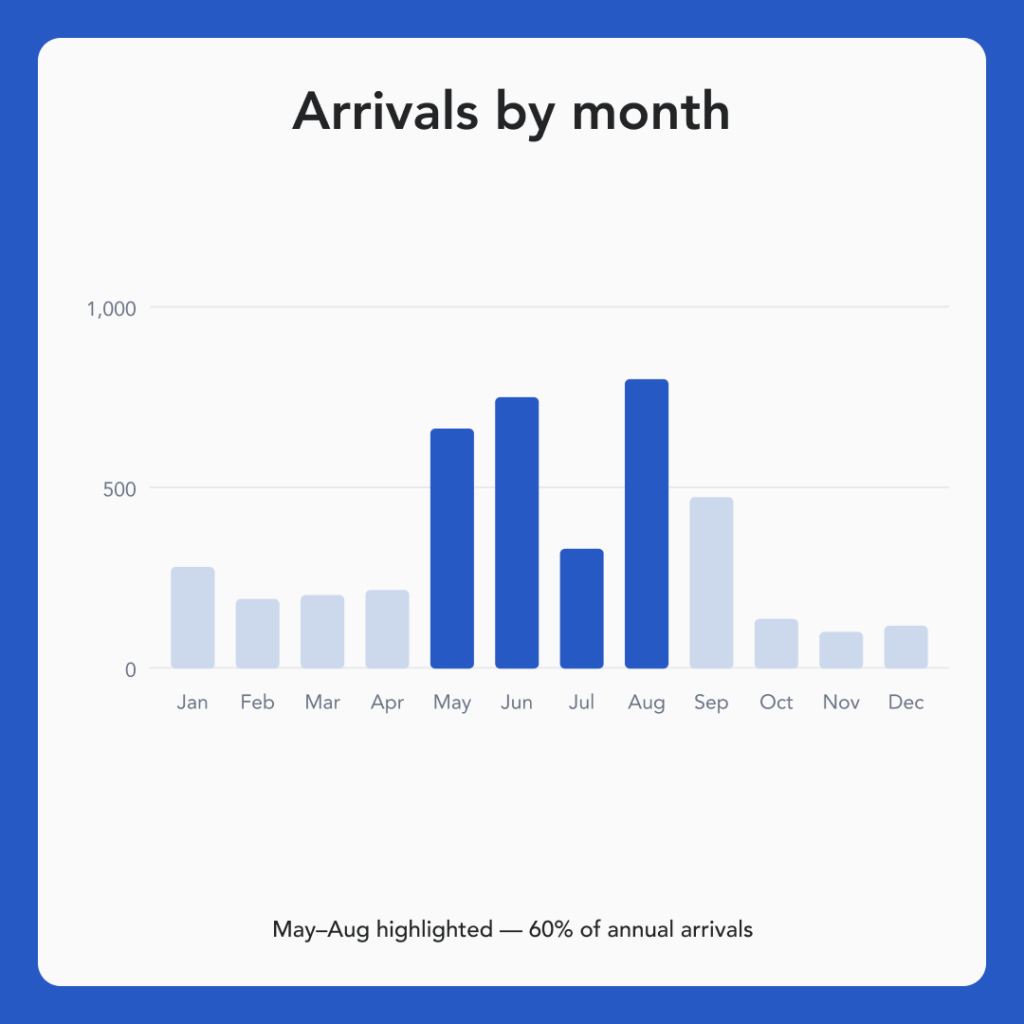
60% of student tenants arrived between May and August. August alone is the single largest arrival month in the entire dataset. January and September, the two standard academic semester starts, account for a combined 18% of arrivals, a secondary peak that sits well below the summer concentration.
This isn’t a random pattern. It maps directly onto two parallel calendars: the internship cycle, which typically runs May through August, and the academic year, where international programs and exchange students often begin in the fall after summer orientation periods. The result is a highly predictable demand curve, not year-round background noise, but a concentrated seasonal wave tied to specific, recurring life moments.
The predictability matters because it affects how student housing should be thought about from a supply perspective. The demand isn’t speculative. It appears, at roughly the same volume, on roughly the same schedule, year after year.
Students come back
12% of students in our dataset booked more than one stay , a meaningful retention signal in a segment often assumed to be purely transactional. In a category where most renters are, by definition, moving for a fixed-term reason, a repeat booking rate above 10% suggests the experience is doing something right beyond just solving a logistical problem.
This cohort also tends to span longer total relationships with Outpost Group, a first summer stay followed by a return for a second internship, or a semester abroad followed by a post-graduation move to the same city. The student-to-young-professional pipeline is real, and the data suggests a portion of it moves through the same housing channels.
What the data shows about the market
Taken together, these numbers describe a student renter population that is larger, more international, more budget-constrained, and more flexibility-dependent than the standard US rental market is designed to accommodate. The demand is consistent, seasonal, and increasingly global, and the gap between what this segment needs and what the traditional market offers has remained stubbornly wide.
We plan to keep tracking this. The 2026 figures build on two prior years of data, and the patterns have been consistent throughout. Behind those patterns are the same students, arriving every year, running into the same walls for the first time.
Methodology
Survey conducted June 2026 with 130 current and former Outpost and June Homes tenants. Occupation, budget, move reason, and housing priority data derived from survey responses. Internal behavioral data covers 3,759 unique student tenant records across Outpost’s NYC and DC markets, January 2023–June 2026. International classification based on US citizenship status as recorded at onboarding. Stay length and arrival data reflect completed tenancies.
